This FAQ explains two trading behaviors that may lead to account review:
Order Splitting and Microscalping.
These policies exist to ensure trading activity reflects realistic execution behavior and does not attempt to exploit simulated fill mechanics.
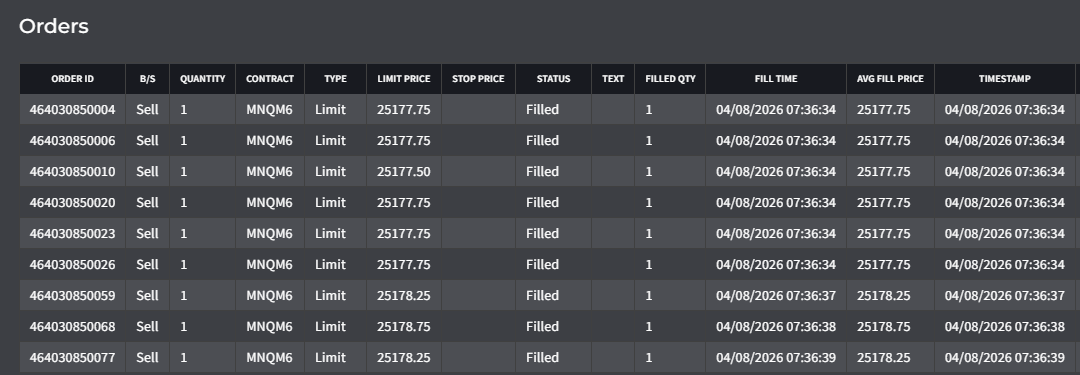
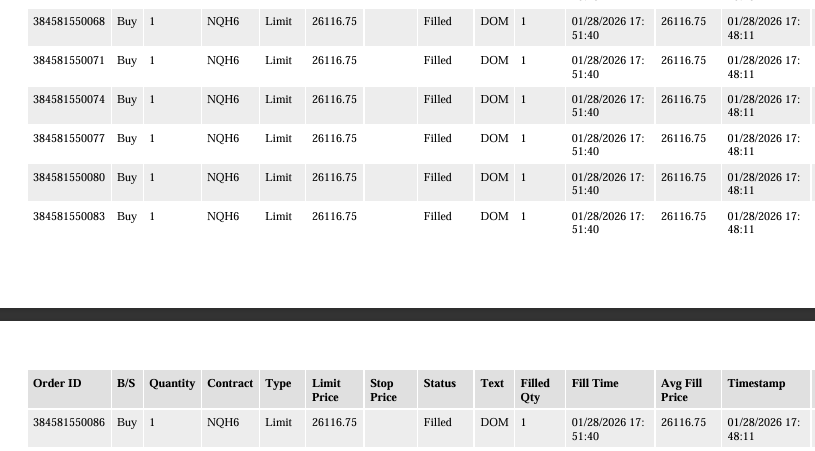
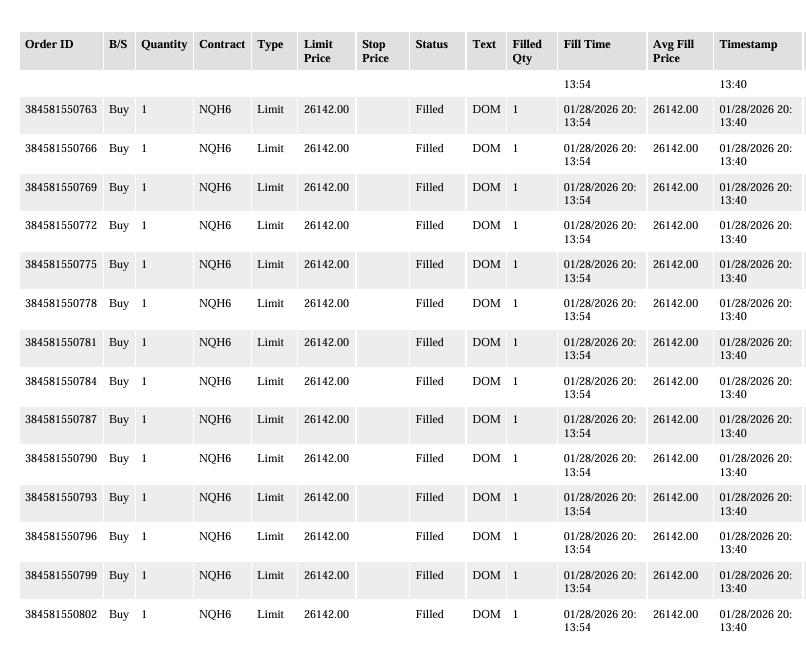
Screenshots of flagged examples are provided below to help illustrate how these behaviors appear in order history.
1. Order Splitting
What is Order Splitting?
Order splitting refers to the deliberate placement of multiple identical orders (same instrument, same price level, same side, and submitted at the same time or within a very short time window) in a way that attempts to influence fill priority or exploit simulated execution mechanics, or fragment what should reasonably be a single order. This applies only to limit orders and stop orders.
This typically appears when a trader intends to enter a larger position but instead places many smaller orders at the exact same price and time.
This includes limit orders placed at the exact same price in individual lot sizes instead of one consolidated order, where the execution structure suggests intentional duplication rather than legitimate scaling.
Order splitting does not include legitimate scaling strategies, staged entries at different price levels, or partial fills from normal market execution.
Example pattern:
Instead of placing one larger order:
Buy 4 contracts at 18,250
The trader places:
Buy 1 contract at 18,250
Buy 1 contract at 18,250
Buy 1 contract at 18,250
Buy 1 contract at 18,250
All submitted within the same moment.
There is no legitimate reason to fragment a single market entry this way.
This structure may simulate queue priority advantages that do not reflect realistic order placement.
What is NOT Order Splitting?
Several common trading behaviors are fully allowed and are not considered order splitting.
Legitimate Scaling
Entering positions at different price levels as part of a strategy.
Example:
Buy 1 contract @ 18,245
Buy 1 contract @ 18,250
Buy 1 contract @ 18,255
This is normal scaling into a position.
Partial Fills
If a trader places one larger order and the market fills it in pieces, this is normal market behavior.
Example:
Buy 5 contracts at 18,250
Market fills:
2 contracts → then
3 contracts
This is not a violation.
Platform-Generated Exit Orders
Some platforms (such as NinjaTrader trailing stop features) may automatically split exits into smaller orders when closing a position.
Example:
A 5-contract position closes as:
1 + 1 + 1 + 1 + 1
This can occur due to platform order management and does not automatically indicate order splitting.
Examples of Non-Compliant Behavior
Example 1
A trader intends to buy 5 contracts of NQ at 18,250.
Instead of submitting one 5-lot order, they submit:
1 lot @ 18,250
1 lot @ 18,250
1 lot @ 18,250
1 lot @ 18,250
1 lot @ 18,250
All within the same timestamp cluster.
This pattern repeats across multiple trading sessions.
Example 2
A trader places numerous identical limit orders at the same price, cancels them frequently, and re-enters the same cluster repeatedly.
This creates an unusually high number of identical orders relative to fills.
How Order Splitting Is Identified
Order splitting typically appears through patterns such as:
Multiple identical limit or stop orders placed at the same price
Orders submitted within the same second or millisecond cluster
Frequent cancel-and-replace behavior with identical orders
The pattern repeating across multiple trading sessions
Our automated systems identify potential Order Splitting patterns. Our team then reviews order history, timestamps, and execution behavior to determine and confirm whether Order Splitting is present.
Screenshots of flagged order history examples are shown below.
2. Microscalping
What is Microscalping?
Microscalping refers to a trading pattern where positions are opened and closed within extremely short timeframes, typically under 10 seconds, in order to capture very small price movements.
General scalping strategies are allowed.
Microscalping becomes a compliance concern when ultra-short trades dominate the account’s activity or profitability.
When Does Scalping Become Microscalping?
Microscalping may be identified when one or more of the following patterns occur:
Time-Dominant Microscalping
Most trades are held for less than 5–10 seconds.
Profit-Dominant Microscalping
A majority of account profits come from very short-duration trades even if other trades are held longer.
High-Frequency Burst Trading
The account executes large clusters of trades in a short period, often relying primarily on execution speed rather than structured setups.
Examples of Non-Compliant Behavior
Example 1
A trader executes 120 trades in one session.
85 trades are held under 8 seconds.
72% of the total account profit comes from trades held under 10 seconds.
This indicates the strategy is dominated by microscalping.
Example 2
A trader executes several trades under 5 seconds that generate most of the session's profit, while longer trades contribute very little.
Examples of Acceptable Behavior
Example 1
A trader exits quickly during unexpected volatility (3–5 seconds), but the majority of trades are held significantly longer.
Example 2
A trader executes a mix of short and longer trades, with most profits coming from trades held well beyond 10 seconds.
How Microscalping Is Reviewed
Accounts may be reviewed for:
Percentage of trades held under short durations
Percentage of profit generated from short-duration trades
Average trade hold time
Trade frequency within short time windows
Whether the pattern repeats across multiple sessions
Key Takeaway
Trading activity should reflect normal discretionary trading behavior, not patterns designed to exploit simulated execution mechanics or ultra-short execution bursts.
If a trading pattern consistently shows:
clustered identical orders at the same price
unusually dense execution patterns
or ultra-short hold times dominating performance
the account may be reviewed for compliance.
Policy Enforcement & Consequences
If trading activity is determined to violate the Order Splitting or Microscalping policies, the following actions may be taken depending on the severity and frequency of the behavior.
First Instance
If a trader’s account is found to be engaging in non-compliant behavior for the first time, the account may be:
- Reset, whether it is an Evaluation account or a Funded Sim account, and
- The trader will receive a formal warning explaining the violation.
This reset allows the trader to continue trading while correcting the behavior.
Second Instance
If the same behavior continues after a warning and reset, further enforcement actions may be taken.
These may include:
- Profit deduction
- Account reset
- Account suspension
The specific action will depend on the severity and persistence of the behavior.
Severe or Intentional Violations
In extreme cases, where the behavior clearly demonstrates intentional attempts to exploit simulated execution mechanics or repeatedly bypass trading rules, the account may be:
- Suspended immediately, even on the first offense.
These cases are reviewed and confirmed by the Head of Trading before action is taken.
Important Note
TradeDay reviews accounts based on overall trading patterns, not isolated individual trades.
Our goal is to ensure that trading activity reflects consistent, realistic market behavior.
If you are unsure whether your trading strategy may fall into these categories, we recommend adjusting your order placement and holding patterns accordingly.
Was this article helpful?
That’s Great!
Thank you for your feedback
Sorry! We couldn't be helpful
Thank you for your feedback
Feedback sent
We appreciate your effort and will try to fix the article